THE SNOW FORT
A Story About Courage, Compassion & What We Miss as Adults
I was six years old, in grade one, and already carried more weight on my shoulders than most kids my age. Home was rough. Mornings were quiet in all the wrong ways, and my clothes were whatever someone else had grown out of. I didn’t mind much — but the other kids did.
Every day on the school bus, a boy reminded me that I looked poor.
At school, he kept at it.
Tugging my sleeves.
Jabbing at my hand-me-down boots.
Laughing loud enough so the whole hallway heard.
When you’re that young and already tired, you learn to stay small. You learn to be quiet. You learn to disappear.
Then one Monday, everything shifted.
Our teacher stood at the front of the class, speaking gently.
“A new student is joining us today,” she said. “She has a prosthetic arm. She is just like you — she can do everything you can.”
And she could.
She was bright, careful, shy but determined.
I watched the way she tried so hard to fit in, and maybe I recognized a bit of myself in her.
A week later the entire school went outside to build snow forts. It was the kind of winter day that felt like magic — fresh snow, rosy cheeks, kids everywhere rolling giant snowballs across the yard.
I was smoothing down the wall of our fort when that same boy — the one who bullied me — stepped in front of the entrance. He jabbed a finger toward the new girl.
“She can’t come in here,” he said.
Not teasing this time.
Just mean.
Final.
I looked at her face — the way she froze, pretending it didn’t hurt.
And something inside me finally cracked.
“She’s coming in,” I said. My heart was pounding, hands shaking inside my wet mittens.
He smirked. “Who’s gonna stop me?”
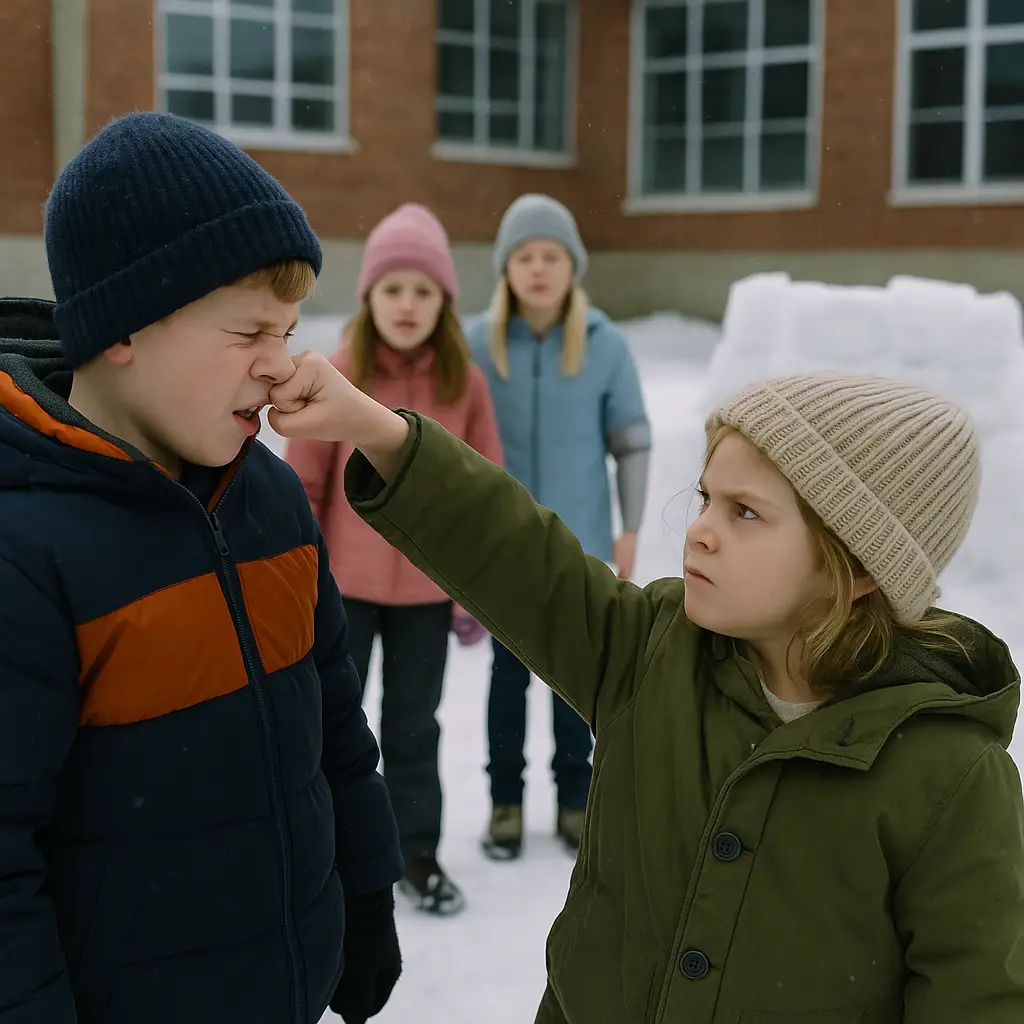
Before I even realized what I was doing, my little fist flew straight into his nose.
There was shouting. Tears. A lot of blood.
Within minutes, I was marched to the office and sent home.
And here’s the part adults might expect to go differently:
My dad didn’t yell.
He didn’t lecture me.
He didn’t say I embarrassed him.
He pulled in a slow breath, nodded once, and said,
“Good. Nobody gets to push people around.”
For the first time in my life, I felt like a hero.
A tiny, shaky, snow-soaked hero who had finally stood up — not for herself, but for someone who needed it.
But now that I’m grown, I see the full story.
And it breaks my heart a little.
Yes, I’m proud that I stood up for her.
Yes, I’m glad she felt protected.
Yes, I would do it again.
But I now understand something nobody noticed back then:
That boy — the one who bullied me, who tried to shame her, who lashed out at so many kids — needed help too.
He needed support.
He needed someone to ask why he was so angry.
He needed adults who looked deeper than the behavior and saw the child behind it.
No one did.
He got in trouble.
He got punished.
He got labelled.
But he never got help.
And I often wonder where he ended up.
Did he soften as he grew older?
Did someone finally listen to him?
Did he ever feel safe enough to stop hurting others… or did he carry that pain into adulthood?
I’ll never know.
But I do know this:
Bullying isn’t just about the child who gets pushed down —
it’s also about the child who keeps doing the pushing.
Both kids need support.
Both kids need understanding.
Both kids need adults who see them, not just their behavior.
Back then, I thought I was defending a friend.
Today, I realize there were two children on that playground who needed compassion —
only one of us received it.
Key Take Aways for Parents and teachers
See all the kids. The child being bullied and the child bullying are both telling us they need support.
Look under the behavior. Ask what pain, stress, or confusion might be driving the behavior — not just how to stop it.
Respond, don’t just punish. Consequences matter, but they should come with connection, guidance, and a plan to do better.
Grow upstanders. Celebrate kids who speak up safely for others. They are powerful leaders in shifting school culture.
Create safe ways to talk. Journals, anonymous notes, and quiet one-on-ones can reveal what isn’t visible on the playground.
Partner with families. Share concerns early and invite caregivers into the solution, not just into a disciplinary meeting.